Chitwood - 1926


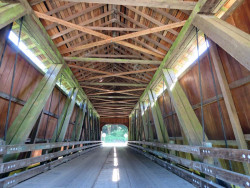


The 1926 Chitwood Bridge is a covered bridge in Lincoln County, Oregon. The bridge crosses over the Yaquina River at Chitwood. Historically, Chitwood was a station on the railway line between Corvallis and Toledo, named after Joshua Chitwood, who lived nearby during the construction of the railway from 1881 to 1885. Trains still use the railway, but they no longer stop in Chitwood, converting it to a ghost town, far from resembling the bustling railroad village it once was.
In December 1893, the first bridge in Chitwood was constructed in the very spot where the covered bridge stands today, allowing residents of Chitwood to cross the Yaquina without fording the river. In 1904, another bridge replaced the prior; however, it was also uncovered. These bridges did not stand up well in the harsh weather conditions in the coastal range.
In the year 1926, the first covered bridge was constructed in Lincoln County. This 96-foot bridge was built by Otis Hamer and designed by A.E. Marvin, stood in place until being rehabilitated in 1984 by federal and county funding and reconstructed by Aubrey Mountain Construction. The reconstruction was historically accurate as the construction company rebuilt the Howe Truss design and the board and batten siding. The weight limit for the Chitwood Bridge is eight tons. The simple structure of flared sides and semi-elliptical portal arches, as well as the barn red color, are characteristics of Lincoln County's bridges.
Chitwood is the product of Oregon's history at work. It began as a railway stop along the Corvallis-Yaquina railway, which ended in the town of Toledo. Chitwood was the end of the line for several pioneers in Oregon. Chitwood was founded by its namesake, Joshua Chitwood, the first postmaster and store owner of the town. Chitwood was a bustling railway town that grew as supplies, logging products, and passengers traveled along the railway lifeline and stopped at Chitwood's depot. Some of the items that came to, and left from Chitwood were fur pelts and hides, carloads of baled moss, chittam bark, lumber, groceries, clothing, cream, and medicine. With the onset of World War I, hard times hit many small towns in Oregon. Inhabitants of Chitwood and the surrounding areas went off to war, and towns became much smaller. Today, it is a quaint residential, pastoral town in which the railcars no longer stop.
Not much activity occurs at Chitwood anymore. The Chitwood Bridge was once surrounded by several stores, a post office, a telephone office, and several houses. The boarded-up remains of the Smith store nearby is a dim reminder of the vitality the community once had.
Logging in the area once boomed enough to support not only the stores, but also contributed to rowdy times in the Chitwood Dance Hall. In the early 1900s, Chitwood became an important rail stop for the steam locomotives from Yaquina to Corvallis, as the town was where the engines took on water and fuel, as well as passengers and freight.
The rails near the bridge are still used, but the train no longer stops at Chitwood. In 1982, Lincoln County officials announced that the bridge had been seriously damaged and would either be replaced or repaired. A public hearing concerning the future of the bridge influenced the commissioners to completely rehabilitate the structure.
Following environmental studies and engineering reports, a contract was awarded the following year to Aubrey Mountain Construction for the rehabilitation work. Supervision was provided by John Gilliland, who had helped build the covered Belknap Bridge in Lane County in 1966.
By December 1983, work had been completed on the roofing, flooring, siding, and approaches, costing in excess of $240,000. Dedication ceremonies in January 1986 included a recitation of the history of the area and a parade of vintage cars. [1] [2]
The structure was added to the National Register of Historic Places in 1979.
Located at: N44 39.254 W123 49.062 - WGCB #37-21-03
Photographed in May of 2025
Photos by Millard Farmer
[1] Yikipedia.com
[2] Oregon.com