Oregon Creek - 1860


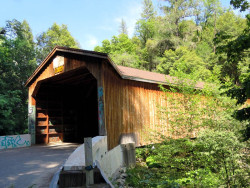
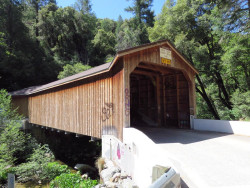
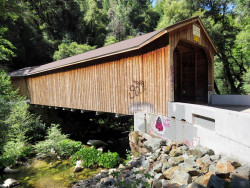


The 1860 Oregon Creek Covered Bridge in Yuba County, California, is a historic bridge spanning Oregon Creek just above its confluence with the Middle Yuba River. This 105-foot, single-span bridge is located approximately 3 miles northeast of the community of North San Juan within the Oregon Creek Day Use Area of the Tahoe National Forest.
The bridge was rehabilitated in early 2018 and is open to light motor vehicles with a 5-ton weight limit. This rehabilitation involved replacing the entire cover and reworking the abutments. Prior to this, the bridge was officially closed to all traffic, but pedestrians could access it. The National Bridge Inventory lists it as "structurally deficient." The roof is now covered with corrugated metal sheeting, and the deck is supported by metal I-beams.
The following description was written in 1974 on the Nomination Form for the bridge's inclusion on the National Register of Historic Places: “The hand-hewn wooden Ponderosa Pine beams are approximately 16 inches square and are still sound. The sides consist of wooden siding, and the structure originally had a shake roof. The abutments were originally of unmortared stone construction. The east abutment appears to be as originally constructed; however, the west abutment was faced with concrete at some later date. Yuba County replaced the wooden siding and replaced the shake roof with one of corrugated tin because of the snow loads, some 40 to 50 years ago.”
The bridge has become a popular spot for graffiti enthusiasts as there is extensive graffiti inside the bridge.
The Oregon Creek Covered Bridge has been used continuously since its construction over a century ago. The actual construction date is in question, however. Documentation indicates that Tom Freeman built a bridge across Oregon Creek in 1858 and in 1871, built another a little above the first at a cost of $2,500.00. The original bridge was washed away after the construction of the new bridge. Other references quote various dates, including 1860, 1861, and 1862, as the year that the bridge was constructed.
Tom Freeman operated it and another bridge across the Middle Yuba River nearby, as toll bridges, until he died in 1892. Yuba County then acquired the bridge and still operates it. The date of acquisition is unverified but is thought to be about 1910. The bridge is unique in covered bridge building in that the portals are angled on the western end.
In 1883, the failure of the English Dam far upstream on the Middle Yuba River sent a mass of water flooding downstream. The high flood waters surged upstream in Oregon Creek, lifted the bridge from its abutments, and carried it away. When the flood waters subsided, the bridge was found some 50 yards below its original location. Mr. Freeman hired a logging contractor, Solon Chatfield, to return the bridge to its abutments. However, during the flood, the bridge had been turned end for end, and the west end of the bridge was placed on the east abutment, and the east end on the west abutment, as it has remained to the present time.
Historically, the bridge served local mining and logging communities and carried traffic on what was called Allegheny Ridge Road, part of the Henness Pass Road, a major freight hauling route over the Sierra Nevada via Henness Pass after the Comstock Lode discovery in Virginia City in 1859 sparked a Nevada mining boom. This route was attractive because goods could be shipped up the Sacramento River from the San Francisco Bay to Marysville before being loaded onto wagons for the trans-Sierra journey.
Oregon Creek Bridge was added to the National Register of Historic Places in 1975.
Located at: N39 23.809 W121 04.943 - WGCB #05-58-01
Photographed in May of 2025
Photos by Millard Farmer