Bridgeport - 1862


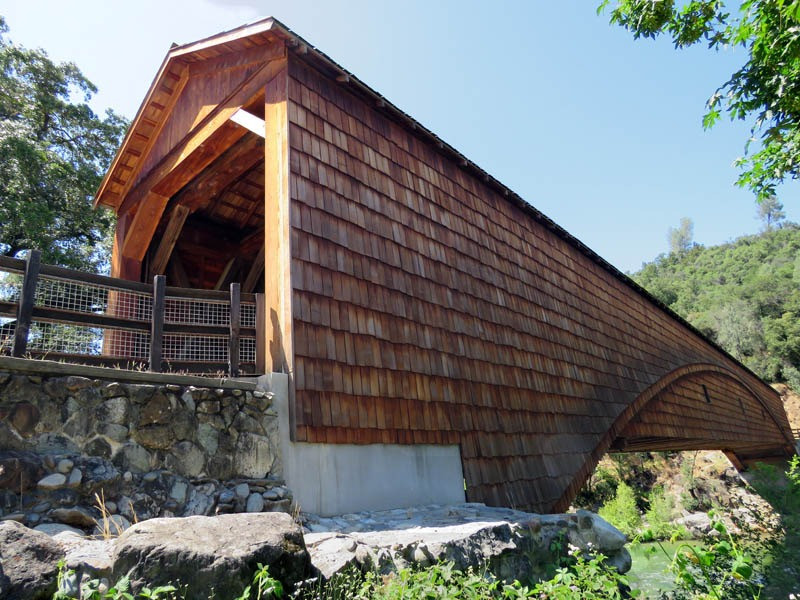

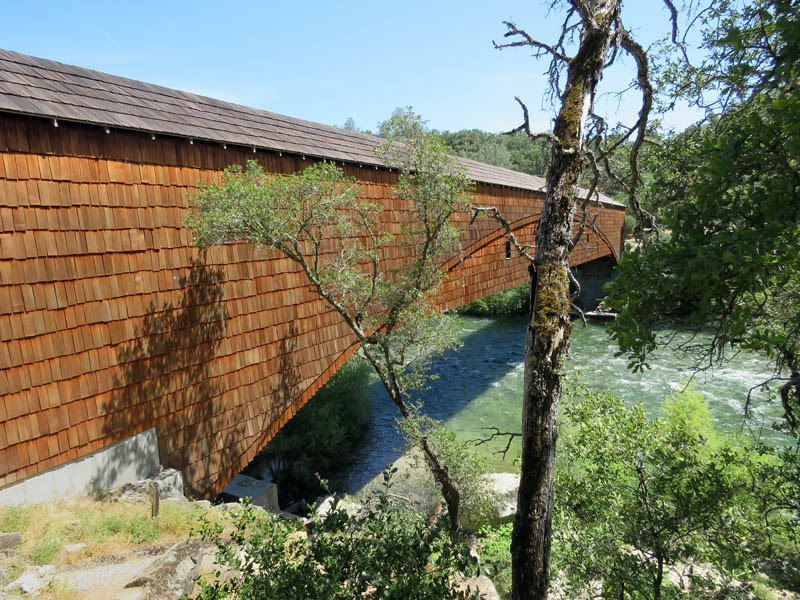


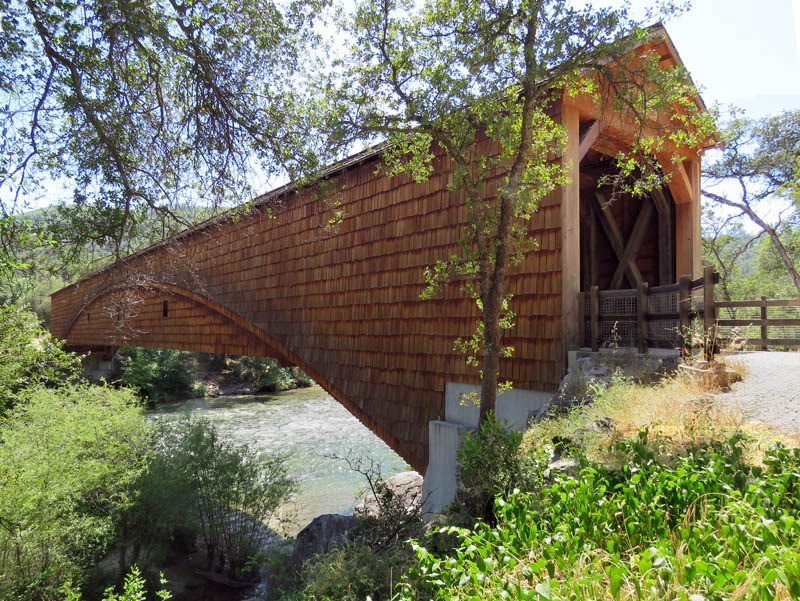


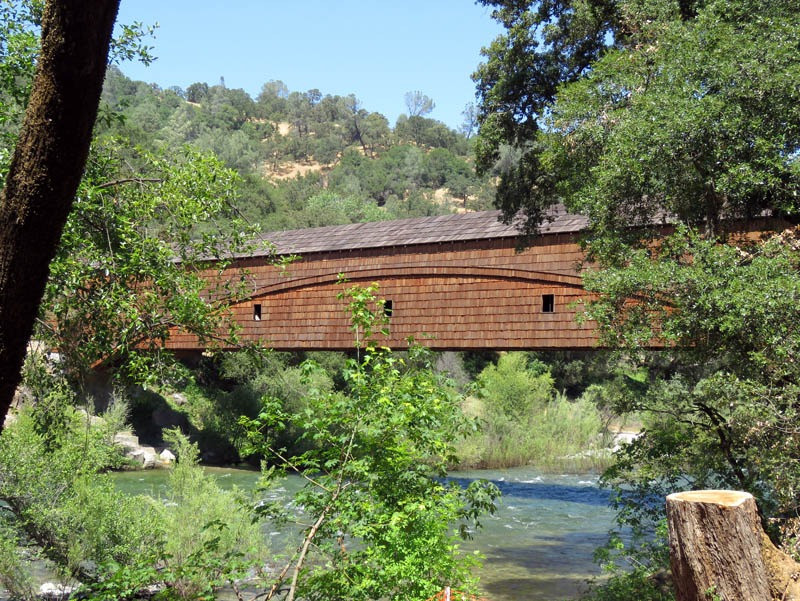


The 1862 Bridgeport Covered Bridge or Nyes Crossing is located in Bridgeport, Nevada County, crossing over the South Yuba River. The Bridgeport Covered Bridge has the longest clear single span of any surviving wooden covered bridge in the world. This 233-foot bridge was built by David John Wood with lumber from his mill in Sierra County. The covered bridge was part of the Virginia Turnpike Company toll road that served the northern mines and the Nevada Comstock Lode. The associated ranch and resources for rest and repair provided a necessary lifeline across the Sierra Nevada. The bridge utilizes a unique combination of a Howe truss and arch construction.
A report by the U.S. Department of the Interior states that the Bridgeport Covered Bridge has clear spans of 210 feet (64 m) on one side and 208 feet (63 m) on the other, while the Old Blenheim Bridge had a documented clear span of 210 feet (64 m) in the middle. With the 2011 destruction of the Old Blenheim Bridge, the Bridgeport Covered Bridge is the undisputed longest-span wooden covered bridge still surviving. Historically, the longest single-span covered bridge on record was Pennsylvania's McCall's Ferry Bridge with a claimed clear span of 360 feet (110 m), built 1814–15 and destroyed by an ice jam in 1817.
The bridge was an important link in a freight-hauling route that stretched from the San Francisco Bay to Virginia City, Nevada, and points beyond after the discovery of the Comstock Lode in 1859 sparked a mining boom in Nevada. Steamboats carried freight from the San Francisco Bay up the Sacramento River to Marysville, where it was loaded onto wagons for the trip across the Sierra Nevada via the Virginia Turnpike and Henness Pass Road. The route across the bridge was ultimately eclipsed by the completion of the First Transcontinental Railroad as far as Reno in 1868 via Donner Pass, but it continued to serve nearby communities in the foothills until improved roads and bridges on other routes drew away most of the traffic.
The bridge was closed to vehicular traffic in 1972 and pedestrian traffic in 2011 due to maintenance and "structural problems".
On June 20, 2014, California Gov. Jerry Brown signed budget legislation that included $1.3 million for the bridge's restoration. The work was slated to be done in two phases—near-term stabilization followed by restoration. The bridge reopened to pedestrians only in November 2021 following completion of the restoration work.
Sridgeport Bridge was designated as a National Historic Civil Engineering Landmark in 1970, and was listed in the National Register of Historic Places in 1971. There are four plaques at the site, with the State Historical Landmark plaque placed in 1964. The landmark was rededicated in 2014.
Located at: N39 17.572 W121 11.695 - WGCB #05-29-01
Photographed in May of 2025
Photos by Millard Farmer